The global wind power industry is accelerating into the era of large-scale turbines. Behind the continuous breakthroughs in single-unit capacity lies an extreme test for the drive train system. As the power hub of wind turbines, the drive train must bear loads exceeding one thousand tons resulting from increased rotor diameters while achieving efficient power transmission within the confined nacelle space. Its performance directly determines the reliability and power generation efficiency of the entire turbine. Among all components in the drive chain, the main bearing stands as the undisputed “load-bearing core”: not only must it simultaneously withstand multiple loads including radial, axial, and overturning moments, but it must also operate continuously and stably throughout its design life cycle. It is arguably the most critical element in overcoming the technical bottlenecks of scaling up wind turbines.
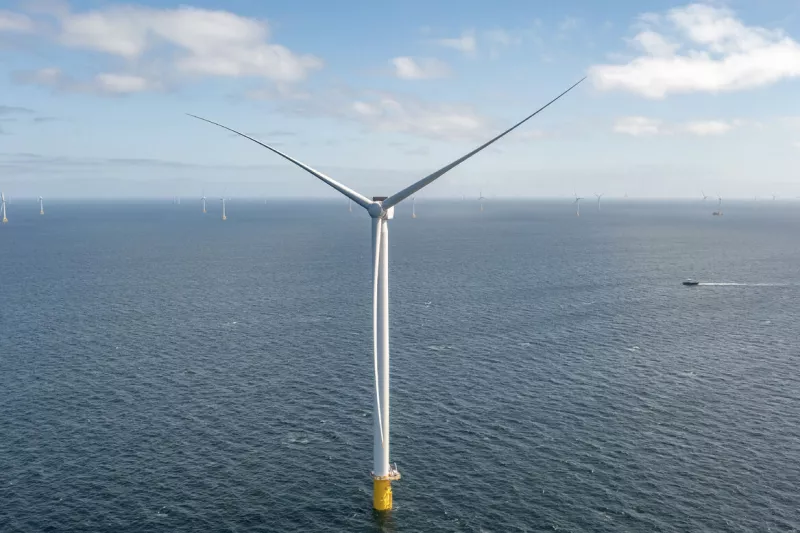
Siemens Gamesa SG DD-276MW Wind Turbine
The Era’s Challenge for the Wind Power Industry: Traditional Main Bearings Struggle to Meet Demands for Larger Scale
Currently, wind turbine drive train technology for units exceeding 8 MW still predominantly uses single-row tapered roller bearings (TRB) or double-row tapered roller bearings (DTRB) as main bearings. However, as these turbines accumulate longer operating hours, the inherent flaws of both designs become increasingly apparent, leading to frequent quality issues.
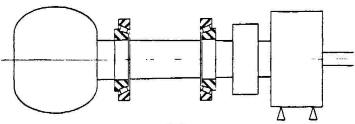
The Structure of TRB+TRB
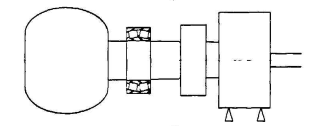
The Structure of DTRB
The HKW three-row cylindrical roller slewing bearing (3CRB), serving as the main bearing under identical operating conditions, has demonstrated a service life exceeding 20 years without exhibiting quality issues comparable to those of TRB/DTRB bearings. This sufficiently demonstrates that three-row cylindrical roller slewing bearings are better suited to meet the main bearing requirements of large-megawatt wind turbines. Against this backdrop, Germany’s HKW leverages its century-long heritage in bearing manufacturing and four decades of wind power technology expertise to focus on designing three-row main bearing drive chain solutions. The company provides breakthrough solutions for wind turbine scaling, delivering value far exceeding that of traditional single-bearing suppliers.
Technological Innovation: New Compact Drive Chains with Spindle-Free Design, Pioneered by HKW
The core innovation of HKW’s new compact transmission chain embodies the deep positioning of HKW’s solution designers: replacing the traditional “dual-bearing + spindle” combination with a three-row cylindrical main bearing, achieving simplification and optimization from the structural foundation of the transmission chain itself, rather than merely upgrading individual components.
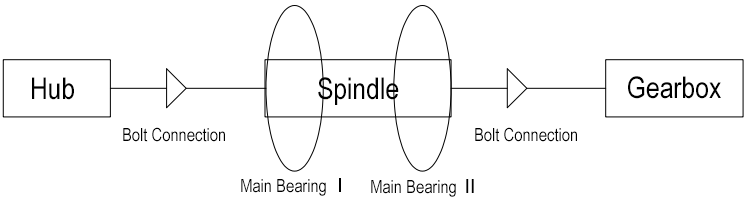
Traditional Drive Train Structure

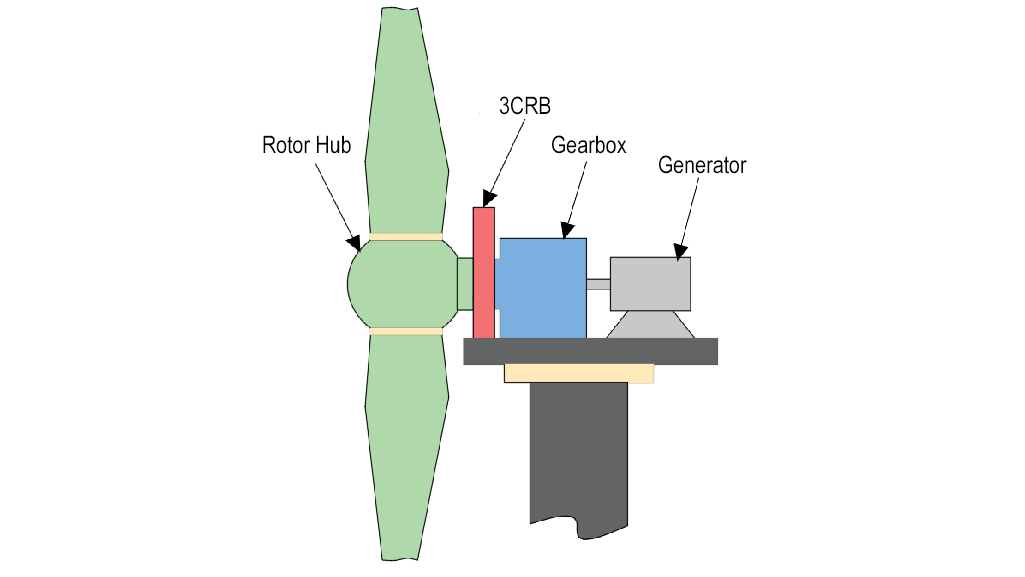
HKW Three-Row Cylindrical Main Bearing Compact Drive Chain Structure
The "de-spindling" design is the result of HKW’s thorough comprehension of the comprehensive needs for wind turbine transmission systems. It reduces the weight of the entire transmission chain by more than 50%, accommodates nacelle space constraints with a compact structure, and handles load challenges with the high load-bearing capacity of three-row cylindrical main bearings. This design further demonstrates HKW’s solution design skills, which go well beyond those of a single bearing provider, and perfectly fulfills the three main objectives of large wind turbines: high efficiency, weight reduction, and space savings.
Breakthrough in Dimensions: 3CRB Main Bearings VS TRB/DTRB, Comprehensive Advantages
The three-row cylindrical main bearing outperforms TRB and DTRB in six key aspects: load capacity, rigidity, installation, efficiency, reliability, and cost.
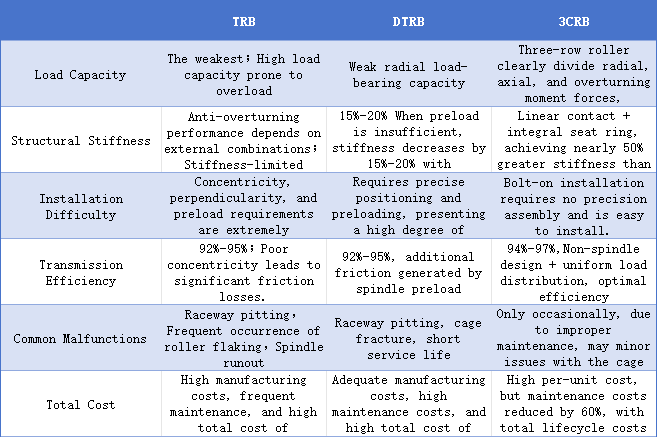
Reliable Verification: Dual Validation from Laboratory to Wind Farm
Leveraging four decades of experience in wind turbine bearing R&D and manufacturing, HKW has continuously advanced its technical capabilities in materials science and heat treatment processes. This has culminated in the development of a high-performance three-row cylindrical main bearing. Its reliability has been thoroughly validated through rigorous laboratory testing and real-world project verification:
Laboratory Testing: In German domestic laboratories, the deformation, load limit, and service life of the three-row cylindrical main bearings meet all of the industry’s highest standards, capable of satisfying the long-term operational requirements of units exceeding 5MW.
Field Application: European project practice demonstrates that the three-row cylindrical main bearings outperform TRB and DTRB main bearings in load-carrying capacity. Even under severe offshore shock loads and high salt fog corrosion environments, they maintain stable performance with no batch failure records.
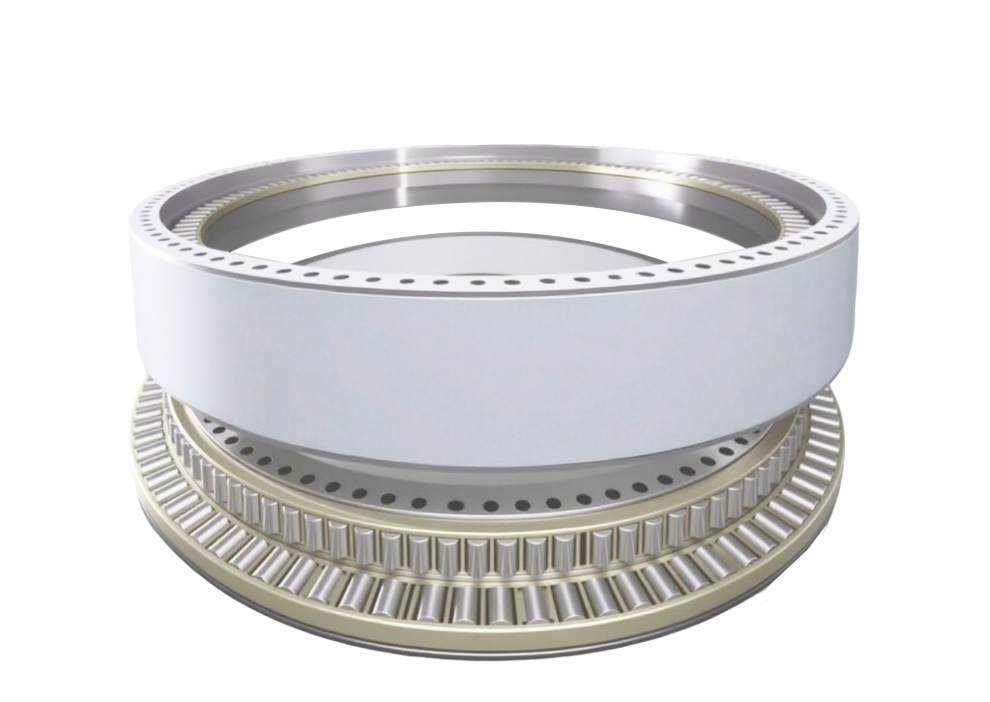
HKW 3CRB
Empowering Industries: Accelerating Wind Power Technology Iteration and Green Development
Since its founding in 1921 and its specialization in wind turbine bearings since 1985, HKW has accumulated technological expertise throughout the industry’s development. It has now become one of Europe’s top three brands in three-row cylindrical main bearings for wind turbines, providing customized solutions and full life-cycle maintenance services to global customers.
By achieving advancements in space, reliability, and cost, HKW's revolutionary compact drivetrain—which is based around a three-row cylindrical main bearing—pushes wind turbines toward higher power ratings and increased integration. With its high reliability and low cost, HKW's innovative compact drive chain not only enables OEMs to improve product competitiveness in the face of the trend toward larger wind turbines, but it also converts wind farm owners' investments into steady returns. Overall, it propels the extensive growth of onshore and offshore wind power by enabling value at both ends of the industrial chain, guaranteeing that technological developments in green energy continuously correspond with the concrete interests of industry players.