The Danish Maritime Authority (DMA) has recently released preliminary survey findings, reconstructing the full sequence of the wind turbine installation vessel collision that took place at the Port of Esbjerg on 10 June and revealing key details of the incident.
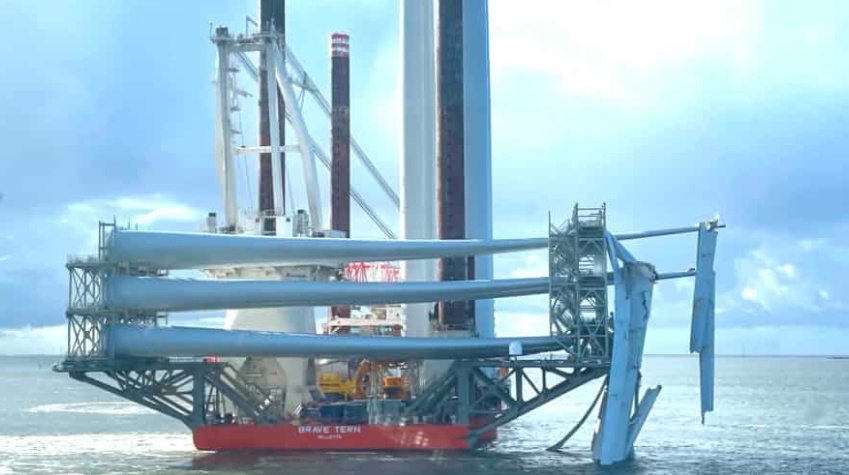
The accident occurred on 10 June. Brave Tern, a wind turbine installation vessel (WTIV) owned by Fred. Olsen Windcarrier, was transporting turbine blades for RWE’s 1.1 GW Thor offshore wind farm. While manoeuvring inside Esbjerg Port, the vessel first struck Cadeler’s WTIV Wind Keeper, which was moored alongside the quay, before colliding with shore-based port infrastructure.
No serious injuries were reported in the incident. However, all nine turbine blades carried on board Brave Tern sustained damage, alongside a 12-square-metre gash on the vessel’s starboard hull. Danish local media estimates the total cost of equipment damage, repairs and consequential losses exceeds DKK 1 billion, equivalent to roughly EUR 134 million.
DMA completed its dedicated on-site inspection the day after the collision. Survey documents show that Brave Tern had just finished a 180-degree turn and was navigating the harbour at a speed of three to four knots when the accident unfolded. During the manoeuvre, a bridge officer moved to the starboard wing to check the clearance between the overhanging blades and the moored Wind Keeper; at that moment, the gap was judged sufficient for safe passage. Moments later, the blades drifted dangerously close, striking the starboard crane of Wind Keeper at 07:41 local time.
Following the impact, the vessel lost heading control and scraped against the quay wall around six minutes afterwards. The crew activated the dynamic positioning system to stabilise the ship, proceeded to a turning basin with tugboat assistance, and later returned safely to berth.
Inspectors confirmed all the vessel’s certificates were valid, crew rest hour regulations had been fully observed, and all navigation equipment operated without fault alarms prior to the collision. Equipment malfunction and crew procedural violations have been ruled out as root causes, while the exact direct trigger of the incident remains under further investigation.
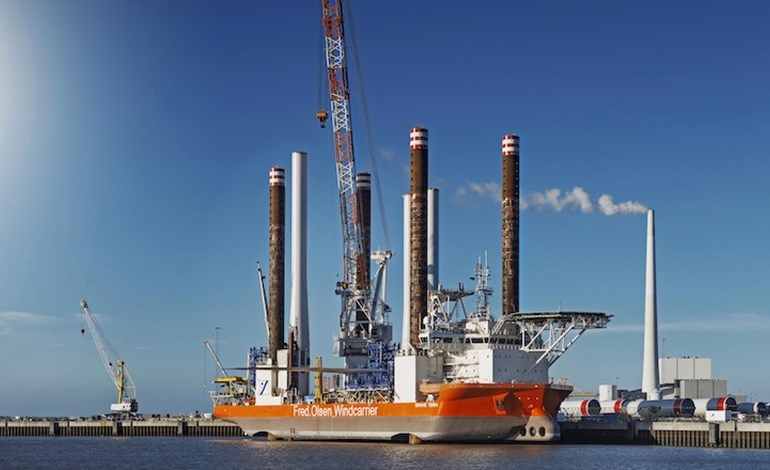
The survey identified a major contributing hazard: wind resistance generated by the oversized wind cargo far exceeded operational forecasts. Tower sections were stowed vertically on deck, and turbine blades extended approximately 60 metres out over the starboard side. The resulting large wind catch area severely impaired the vessel’s handling performance, a critical factor behind the collision.
DMA has issued mandatory safety corrective actions for the vessel. Before Brave Tern departs Esbjerg again, its entire bridge team must hold a dedicated safety debrief to review the accident and implement risk mitigation measures to prevent similar incidents from recurring.