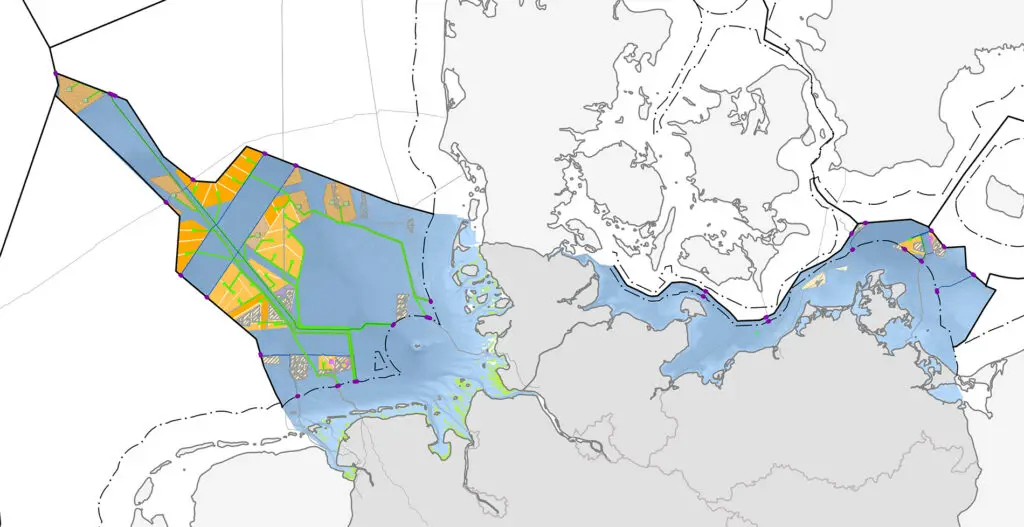
On October 22, Germany’s Federal Maritime and Hydrographic Agency (BSH) released a preliminary draft of the updated Site Development Plan, translating the 70 GW 2045 offshore wind target set out in the Offshore Wind Energy Act into an actionable development roadmap. This means Germany’s offshore wind capacity will expand more than sixfold in less than 20 years, up from the current installed base of around 11 GW.
In line with the statutory timeline, Germany’s offshore wind sector will follow a three-phase ramp-up: reaching 30 GW of cumulative installed capacity by 2030, 40 GW by 2035, and targeting 70 GW by 2045. This draft is designed to secure maritime areas for the post-2030 growth phase, paving the way for subsequent auctions and project development.
On the site supply front, Germany plans to designate 14 new development zones, each with a capacity of approximately 1 GW, supporting around 15 GW of new installed capacity in total and serving as the core growth driver between 2030 and 2038. Meanwhile, 13 long-term reserve sites will be earmarked to underpin further capacity expansion down the line. Unlike the traditional model where developers carry out preliminary work independently, the authorities will conduct centralised, unified surveys for all new sites, directly cutting developers’ upfront investment and planning risks to attract more bidders and stimulate market competition.
In terms of technical design, the draft introduces a counterintuitive parameter: the average power density of new sites in core areas is set at 7.3 MW per square kilometre, lower than the 8 MW/km² upper limit widely advocated across the industry. While it appears to sacrifice installed capacity per unit of sea area, the design actually reduces wake interference by widening turbine spacing, ultimately lifting the overall power output and full-load hours of entire wind farms. This more rational density design safeguards the full-lifecycle returns of projects.
In addition, the plan breaks down national borders for the first time, clarifying that cross-border cooperative projects can count towards Germany’s national installed capacity target, with a priority on advancing cross-border grid-integrated wind development with Denmark. Industry calculations show that low power density deployment in German waters, combined with grid interconnection and coordination with neighbouring wind farms, can expand power supply scale while diluting grid construction costs, driving a significant drop in the levelized cost of electricity.
The draft has now entered the public consultation period, which closes on December 3, 2026. The industry broadly endorses the direction of this long-term plan, while also calling for more stable market-oriented supporting mechanisms to turn the blueprint into tangible investment.
Preliminary Draft of the Site Development Plan