October marks the opening month of Q4 2026. As the starting point for the final year-end push, order performance in this month not only forms a key pillar of companies’ full-year results, but also provides a critical window into their market deployment plans and the industry’s competitive landscape for the coming year.
Today we take stock of the October order performance of Europe’s leading wind turbine OEMs.
First, a note on the statistical scope. Among Europe’s four traditional core turbine OEMs – Vestas, Siemens Gamesa, Nordex and Enercon – Siemens Gamesa and Enercon do not follow the practice of disclosing small and medium-sized orders on a monthly, per-order basis. A large volume of small to mid-sized orders are typically announced collectively in their quarterly earnings reports. As a result, fully traceable official public orders for October are concentrated primarily on Vestas and Nordex.
The statistics below are all based on official order announcements issued by the companies, covering only publicly disclosed portions and not representing the full order volume for the month.
According to publicly available data, Nordex significantly outperformed Vestas in announced orders in October, getting off to a strong start in the fourth quarter. Throughout October, Nordex officially announced 5 turbine orders with a total capacity of 916 MW, while Vestas announced 3 orders over the same period, totalling 592 MW.
Onshore order intake in October 2026
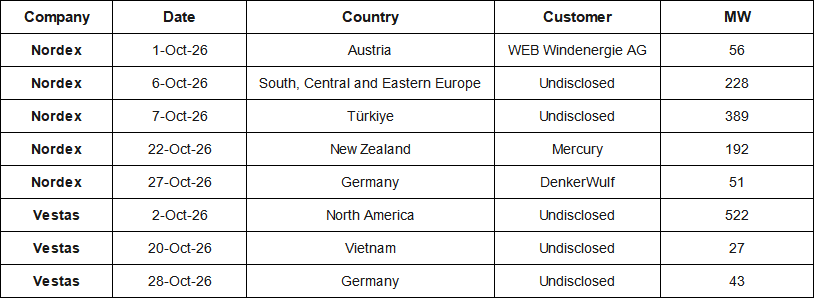
The two companies show distinctly different market footprints in their order structures.
Vestas’ orders remain concentrated in its traditional strongholds. The North American market contributed a large 522 MW order, making it the absolute main driver for the month, with the remaining two orders coming from Germany and Vietnam respectively. Overall, it continues its steady strategy of securing large orders in major markets.
Nordex, by contrast, has a more diversified order distribution. It has continued to win orders in its home and emerging stronghold markets including Turkey, Central and South Eastern Europe, Austria and Germany, while also achieving a breakthrough into a brand-new market with a 192 MW project in New Zealand, marking its first entry into the country’s wind power sector.
Single-month figures carry a certain degree of randomness, but over a longer time horizon, Nordex’s catching-up momentum has become an industry-wide consensus. Industry analysts all note that while Vestas remains the undisputed leader in global onshore wind power, the gap between the two is steadily narrowing: in 2021, Vestas’ onshore turbine deliveries were 118% higher than Nordex’s; by 2025, that lead margin had shrunk to 64%.
Rather than declaring Nordex the winner in this October ranking, it is more accurate to say the two companies are adopting divergent strategic approaches. Nordex is using emerging markets to reduce its reliance on the single European market, while Vestas continues to cement its profit margins in mature markets.
Finally, it should be noted that public announcements alone cannot fully reflect the total order volume of the two companies for the month. More comprehensive Q4 order data will be available when both companies release their quarterly earnings reports. Nevertheless, the performance at the start of Q4 makes clear that competition in Europe’s wind turbine OEM market is intensifying. The catching-up momentum of second-tier players and the subtle shifts in the market landscape merit ongoing attention.