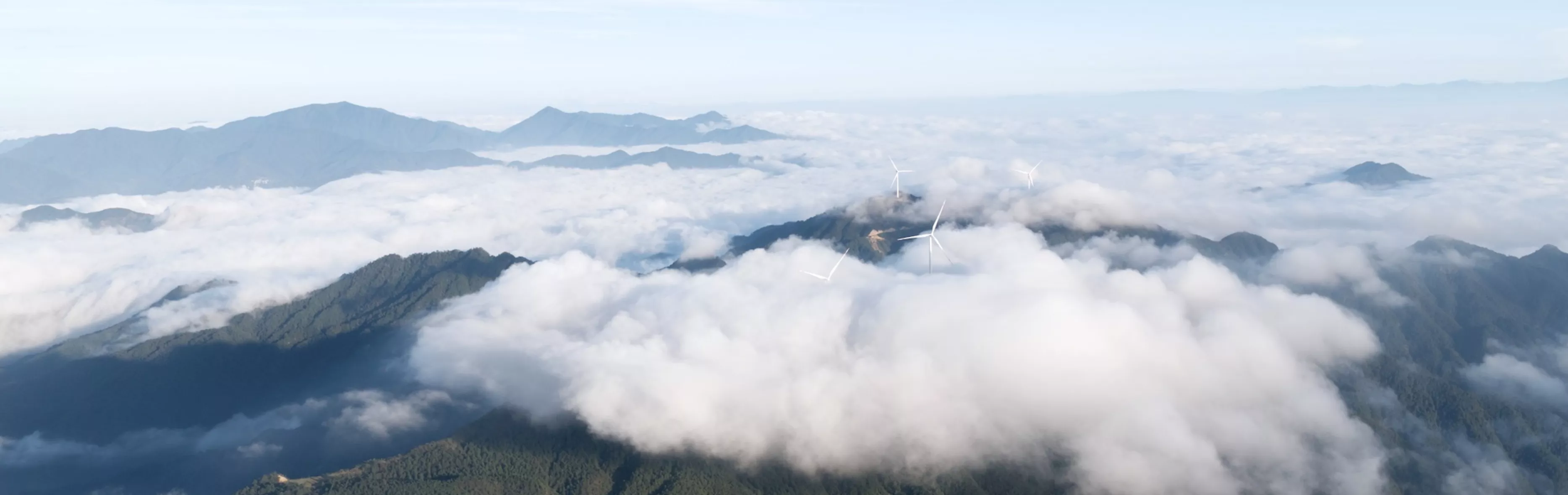
Like all industries, the wind power sector experiences cycles of boom and bust. The year 2025 is likely to become the most challenging year for the wind power industry in recent times: major policy shifts in core markets, operational turbulence among enterprises, coupled with power generation falling short of expectations—these multiple adverse factors will converge to impact the industry's development.
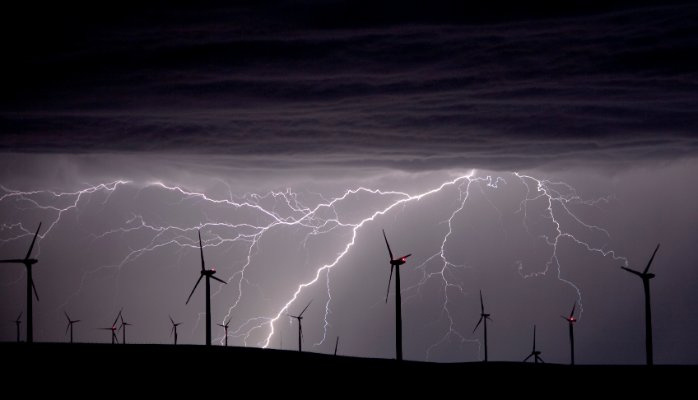
President Trump's abrupt policy shift in the renewable energy sector has delivered the most disruptive blow to the industry. This reversal has directly halted all offshore wind projects along the U.S. Atlantic coast, dealing a severe blow to domestic power developers and wind energy companies alike.
Wind power auction results across multiple European countries have also been dismal, with some nations like Germany and Denmark even experiencing failed auctions. This confirms that the wind power industry's struggles are not unique to the United States but represent a widespread challenge sweeping the globe.
Amidst widespread layoffs across the industry, leading developers pulling out of projects, and core markets experiencing months of below-normal power generation, 2025 has become a “winter year” that the global wind power sector urgently needs to turn the page on.
However, the market still has reason to anticipate an industry recovery by 2026. With adjustments to wind power auction incentive mechanisms, optimization of supply chain layouts, and sustained growth in global demand for various power sources, multiple favorable factors will drive continued expansion of the global wind power sector.
Below we outline the key events impacting the wind power industry in 2025, along with industry highlights for 2026 and beyond.
Growth rate hits a new low in decades
Beyond various external headwinds, the power generation performance of existing wind farms has also dented the industry's reputation as a reliable source of electricity.
In fact, the year-on-year growth rate of global wind power generation in 2025 may hit its lowest level in two decades. This situation stems largely from wind power generation in Europe and North America consistently falling short of expectations over the long term.
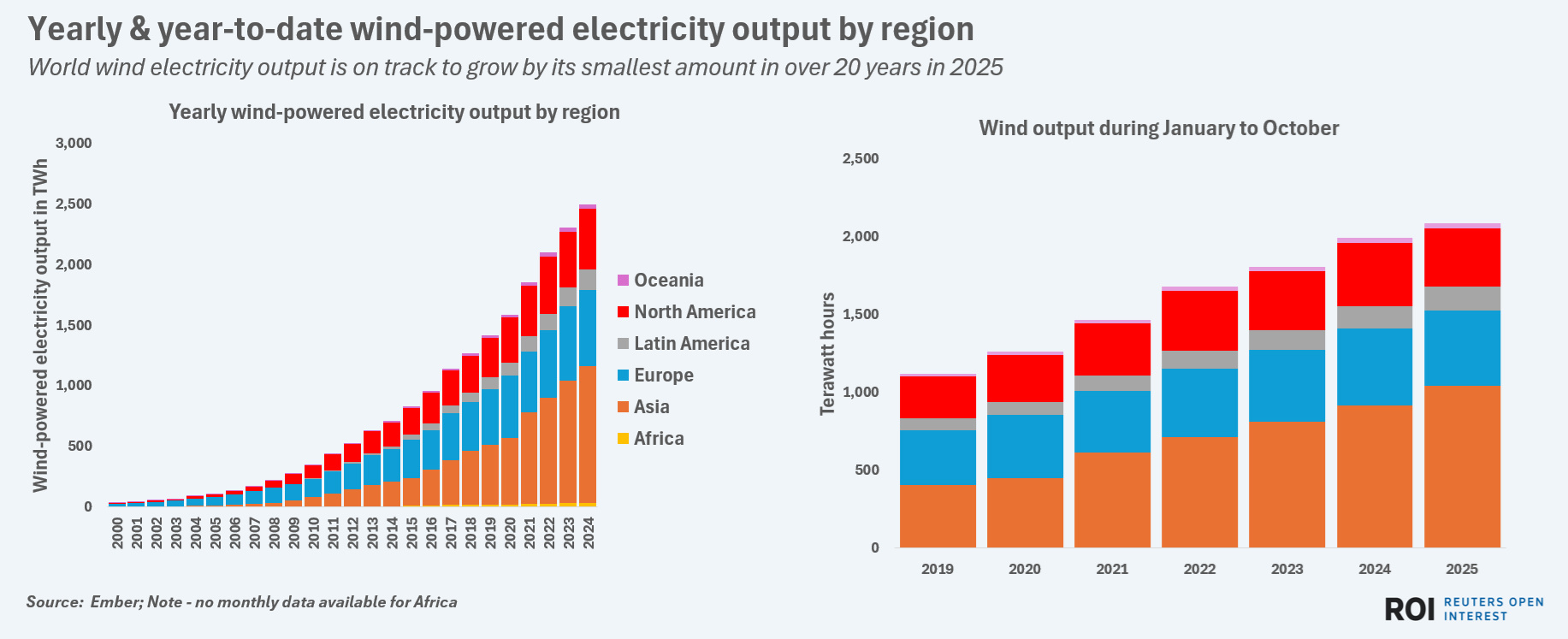
Global wind power generation growth in 2025 may hit a 20-year low
Data from the UK energy think tank Ember shows that from January to October 2025, global wind power generation reached 2,158 terawatt-hours, setting a new record for the same period in history, but representing only a 7% year-on-year increase. In the preceding decade from 2015 to 2024,global wind power generation had grown at an average annual rate of 14%.
Europe, the world's second-largest wind power region after Asia, saw its wind power generation decline year-on-year for four consecutive months in early 2025, becoming the primary factor dragging down global wind power growth.
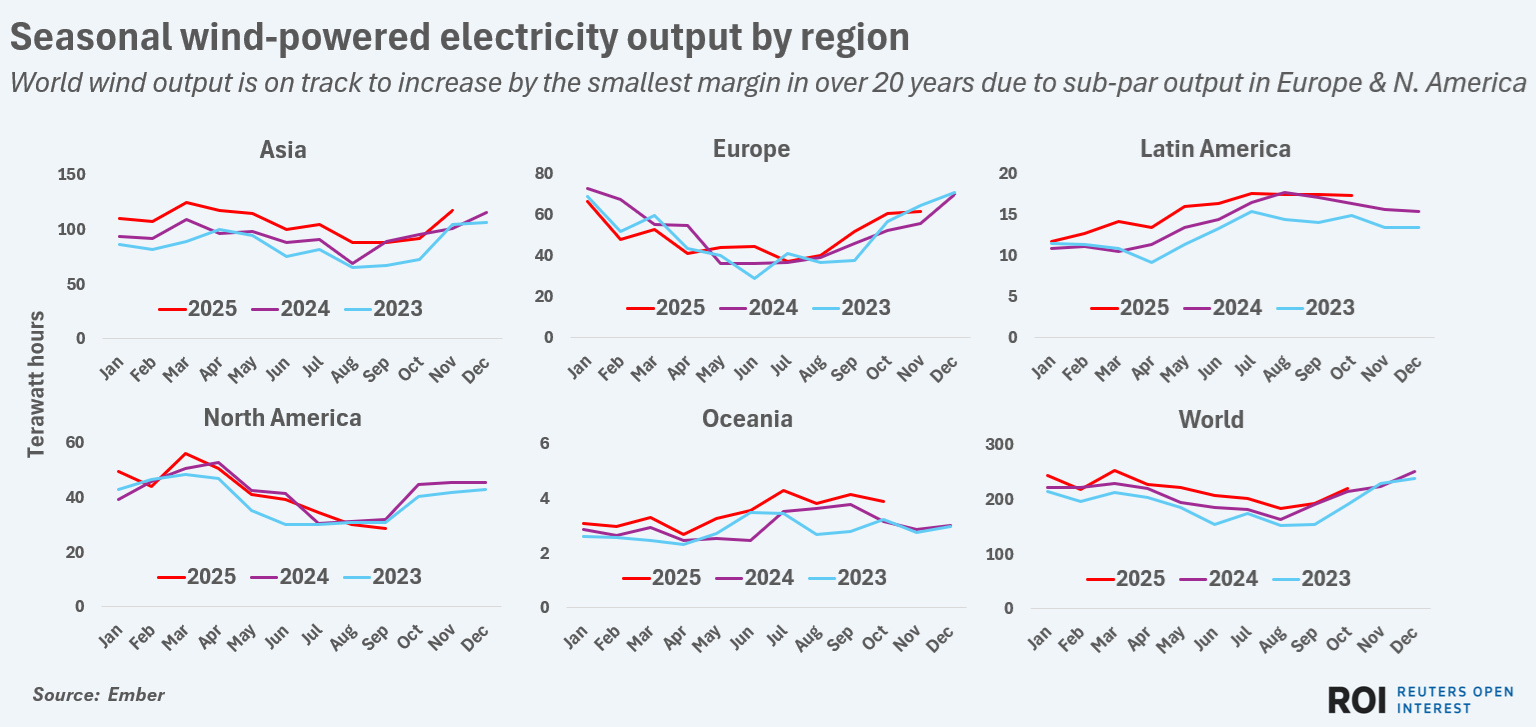
Europe and North America drag down global growth, with wind power generation growth potentially hitting a 20-year low.
North America ranks as the world's third-largest wind power production region, and its industry downturn has further exacerbated the global slump. By mid-2025, wind power generation in North America had declined year-on-year during April, May, June, August, and September.
Even in Asia, which contributes approximately 45% of global wind power generation, wind power output saw an unusual year-on-year decline in September and October 2025, further dampening the momentum of global wind power growth.
Policy upheavals compounded by corporate turmoil
While existing wind farms are failing to meet power generation expectations, sudden major adjustments to national wind power policies and declining participation in wind power auctions have also made it extremely difficult for planned wind power projects to move forward.
In the United States, the Trump administration has halted federal wind power support policies, suspended project permits, and imposed stringent restrictions on imported wind turbine components. Industry experts believe these adjustments will continue to hamper the progress of U.S. onshore and offshore wind power projects for years to come.
In Europe, a series of dismal auction results has prompted leading developers and turbine manufacturers like Denmark's Ørsted and Vestas to call on governments to accelerate project approvals and refine auction terms to boost industry confidence. Some of these proposed policy improvements are expected to take effect by 2026, potentially reigniting enthusiasm for wind power investment across Europe.
The Japanese market has also suffered setbacks: significantly higher cost estimates for planned offshore wind projects have led Mitsubishi Heavy Industries to withdraw from three offshore wind projects originally scheduled to begin operations by 2030.
However, the Japanese government subsequently adjusted its wind power industry policy, granting developers greater flexibility in project development, increasing financial support, and expanding the scope of planning and site selection for offshore wind projects. Similar to Europe's policy fine-tuning, although Japan's wind power sector faced significant challenges in 2025, the policy relaxation is expected to restore market confidence and drive capacity expansion in 2026 and beyond.
China Leads Global Wind Power Growth
Against the backdrop of setbacks in global wind power development, China's wind power industry continues to demonstrate robust momentum. As the world's largest producer of wind power capacity, electricity generation, and component manufacturing, China is poised to achieve its 25th consecutive year of over 10% year-on-year growth in wind power generation by 2025.
By 2025, China's share of global wind power generation will climb from less than 40% in 2024 to a historic high of over 41%.
China's continued expansion of wind power capacity means that even with stagnant growth in the United States and sluggish recovery in Europe, global wind power generation will continue to set new records in the coming years.
Enber data shows that since 2025, China's wind turbine component exports have grown by over 20% year-on-year, surpassing US$4 billion in total value. The sustained export of components has also steadily enhanced wind power equipment supply capabilities across most regions worldwide.
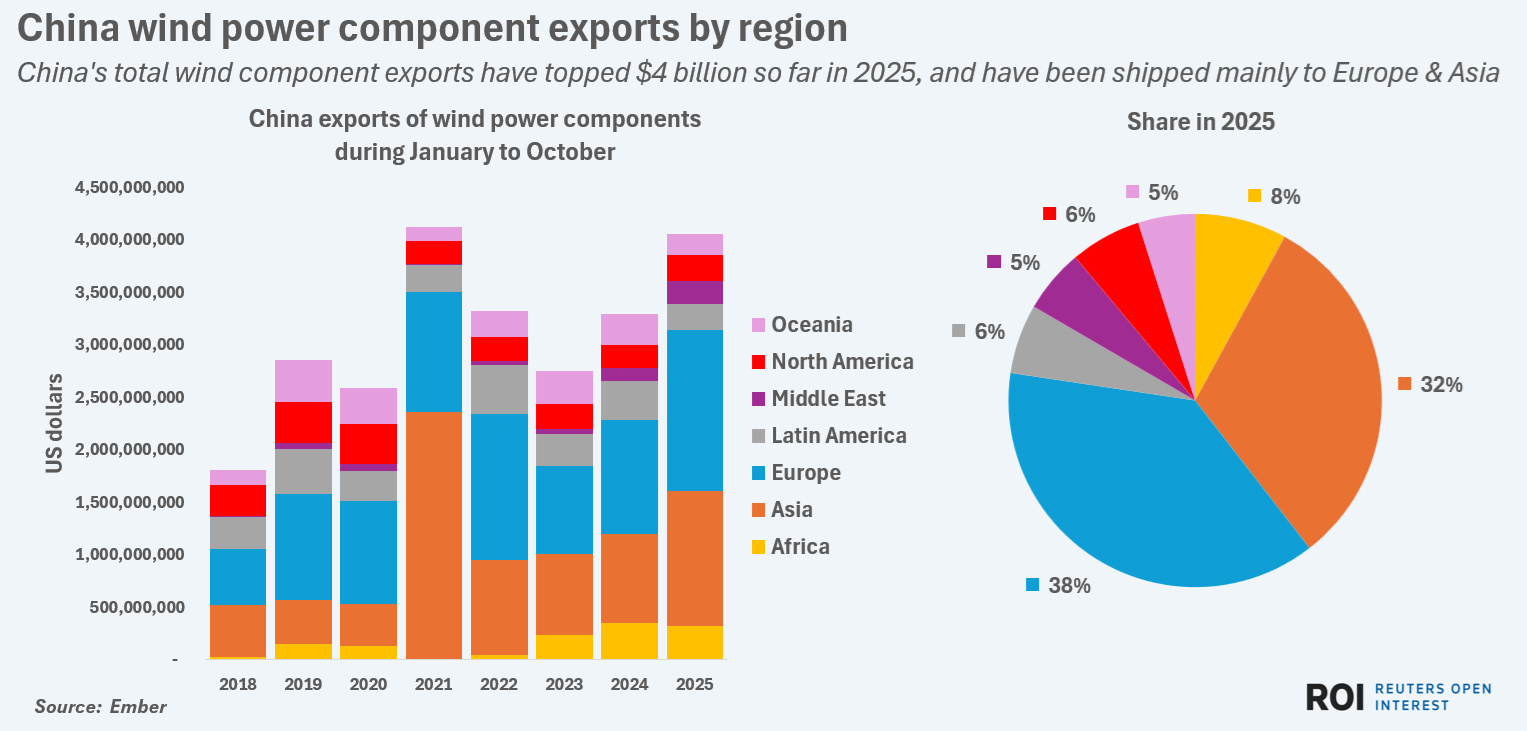
China's wind turbine component exports surpassed $4 billion in 2025, primarily destined for Europe, the Americas, and Asia.
The fundamental demand for electricity remains constant across nations. Coupled with the increasingly mature wind power equipment supply chain, even if the industry experiences significant turbulence in 2025, the global wind power market will continue to expand steadily in 2026 and beyond.
Founded in 1921, Germany's HKW has specialized in wind turbine bearings since 1985, accumulating technological expertise throughout the industry's evolution. Its three-row cylindrical main bearing technology consistently ranks among Europe's top three. Leveraging triple technological expertise in structure, materials, and manufacturing processes, HKW's three-row cylindrical main bearings deliver six core advantages: high reliability, strong load-bearing capacity, enhanced structural rigidity, high transmission efficiency, easy installation, and low overall cost. Whether deployed in onshore wind farms or confronting salt spray corrosion and extreme wave conditions in offshore environments, HKW's three-row cylindrical main bearings significantly reduce turbine downtime and maintenance frequency, delivering efficient performance across all operational scenarios. Deeply rooted in the wind power supply chain, HKW leverages its global localized service network to serve partners worldwide with cutting-edge technology and premium products.