Global wind power installations reached a record high in 2025, yet the industry's momentum shows no signs of slowing at this peak. According to Wood Mackenzie's latest report, 2026 will mark the industry's entry into the “deep waters of structural transformation.” The interplay of policy adjustments, technological evolution, and market restructuring will bring short-term challenges of slowing growth and intensified competition, while simultaneously creating long-term opportunities for offshore wind expansion, cost stabilization, and value realignment. This year, the sector will seek a new growth equilibrium amid both challenges and breakthroughs.
Without further ado, let's dive into Wood Mackenzie's latest report to unlock the seven core trends shaping the wind power industry by 2026 and gain clarity on the sector's future trajectory!
Trend 1: Global wind power installations will show a divergent pattern of “slowing growth in China and expanding growth in other regions.”
Wood Mackenzie forecasts that global wind power installations will reach a record high of 170 GW in 2025. However, new installations are projected to decline by 6% in 2026 to 160 GW. This dip stems primarily from a transitional adjustment as China's 14th Five-Year Plan concludes.
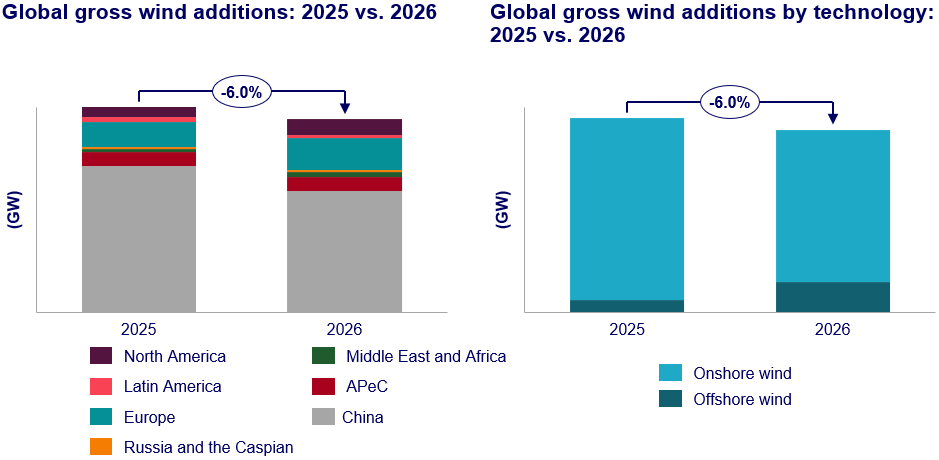
Germany achieved substantial growth thanks to the large number of onshore wind projects approved in 2024. The United States, driven by a rush to install projects before the expiration of production tax credits, became the single largest market outside China.
Trend 2: Offshore wind power tendering enters the 3.0 era, poised to become a key driver for industry recovery.
2026 will mark the “breakout year” for offshore wind power, with new installations expected to double year-on-year, becoming the core driver of industry growth. This breakthrough hinges on the iterative upgrade of bidding models. Addressing failures and project cancellations stemming from subsidy reductions and rigid terms in the previous 2.0 bidding phase, multiple countries worldwide have introduced “Offshore Wind 3.0” tenders. These feature more favorable terms to ensure projects are not only awarded but also successfully constructed.
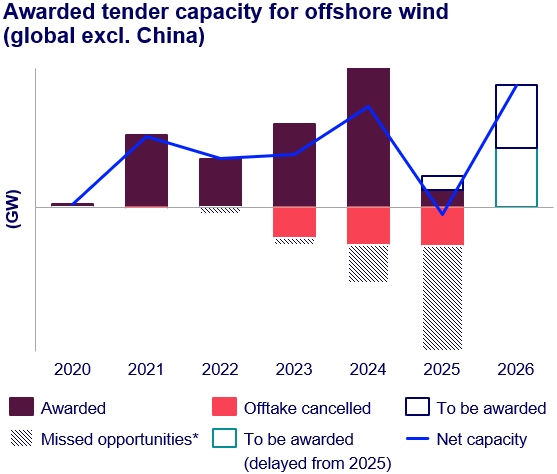
The UK's seventh round of capacity allocation will serve as the first “litmus test” for the 3.0 tender. Wood Mackenzie predicts the new framework will effectively reverse the industry's previous downturn and accelerate the implementation of offshore wind projects. However, the elimination of power purchase agreements will create a construction lull around 2028, with new tender projects concentrated for grid connection in the early 2030s. Improper project deployment timing could trigger renewed supply chain tensions. The optimal solution for policymakers is “decentralized deployment” to avoid supply chain pressures from concentrated project launches, ensuring the industrial chain maintains continuous operations amid cyclical industry fluctuations.
Trend Three: New Challenges for Offshore Wind Power Development Amid China's Market-Oriented Power Sector Reform.
The two-stage market entry mechanism implemented starting in 2025 requires developers to secure development rights before determining returns, leading to stagnant growth in project reserves. This trend may persist into 2026. Although existing approved projects are sufficient to support construction over the next three years, offshore wind power lacks competitiveness compared to solar and onshore wind power under the market-based pricing model. The key focus for 2026 lies in whether China will introduce supportive policies for deep-sea projects, which would directly impact the industry's technological R&D and supply chain development.
Trend Four: The U.S. Wind Power Industry is Deeply Entangled in the Tug-of-War Between Policy and Demand
One Big Beautiful Bill Act stipulates that projects scheduled for commercial operation in 2029-2030 must commence construction by July 2026 to qualify for tax credits, compelling developers to accelerate procurement. Compounded by tariff uncertainties, permitting risks, and the Trump administration's offshore wind construction moratorium, these factors further intensify industry pressures.
However, growth in electricity demand presents an opportunity. By 2030, peak electricity demand in the United States will rise significantly. New loads such as data centers will highlight the need for wind power, potentially prompting policy adjustments to increase feed-in tariffs and spark a surge in industry transactions.
Trend Five: The disposal of aging wind turbines emerges as a new growth driver for the industry.
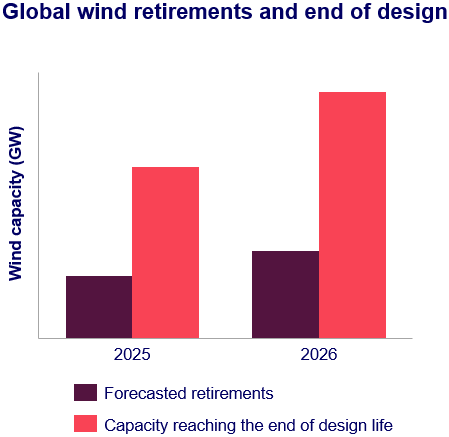
A significant number of wind turbines worldwide have been operating for over 20 years, with another substantial fleet nearing the end of their design lifespans. Decisions on decommissioning will for the first time have a tangible impact on the wind power industry. Driven by financial considerations, developers in mature markets such as Europe and North America are prioritizing turbine lifespan extensions, which will significantly boost demand for retrofitting and capacity expansion. The cost and efficiency advantages of new wind turbines will accelerate the retirement of aging units, creating a new growth driver for the industry through “existing asset renewal.”
Trend 6: By 2026, overall equipment prices will stabilize, with differentiated characteristics emerging across various market segments.
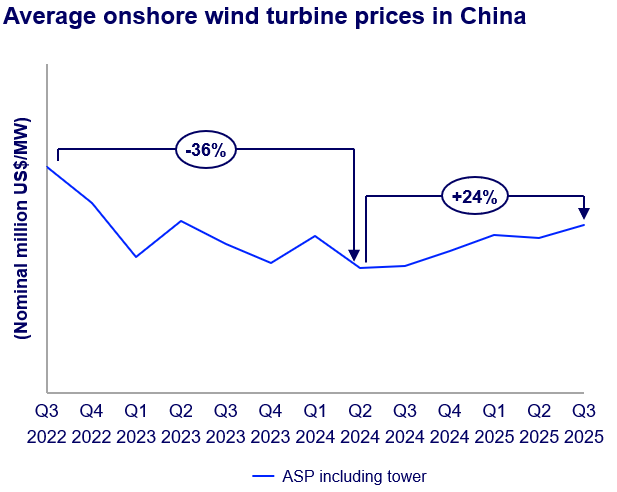
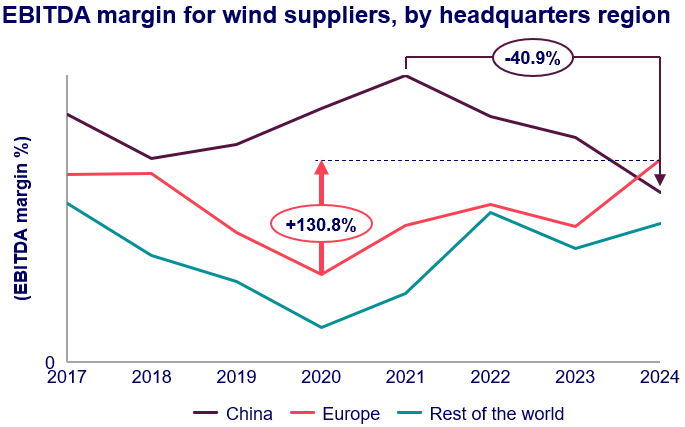
Chinese appliance manufacturers have bid farewell to price wars under the dual influence of industry self-regulation and policy controls. The 2024 Industry Self-Regulation Agreement and the 2025 government policy to curb disorderly competition have effectively limited the downward pressure on turbine prices. Combined with a significant price rebound in 2025, China's wind turbine prices are expected to stabilize in 2026. However, developers may shift the pressure from declining project returns to the supply chain, posing a risk of minor price declines.
Western markets will see cost relief following inflation peaking. 2025 marks the peak inflation year in the West, with pressures like skilled labor shortages and high interest rates gradually easing. Turbine prices will enter a stabilization phase in 2026. Europe will see cost optimization through the scaled deployment of 6-7MW onshore turbines, though the proposed Carbon Border Adjustment Mechanism (CBAM) may complicate procurement and limit cost reduction potential. The U.S. market, dominated by policy factors like tariffs and permitting delays, could still see turbine price increases, with local supply chains facing capacity pressures from developers rushing to install turbines.
Trend 7: Market-Oriented Transformation Drives the Reconstruction of Industry Competition Logic
Core markets like China and Germany are transitioning from fixed electricity pricing to market-based pricing, forcing the industry chain to shift from “cost competition” to “value competition.” Western OEMs have focused on high-end areas like modular design, AI predictive maintenance, and grid integration. To shed the “low-cost” label, leading Chinese OEMs are launching comprehensive solutions including project development and hybrid energy systems, while intensifying efforts on ESG compliance and local manufacturing. This transformation will pit OEMs not only against peers but also against other renewables like solar. As market barriers dissolve, wind power is expected to surpass solar in competitiveness in some regions by 2026.
Conclusion: 2026, the “Year of Transformation and Breakthrough” for the Wind Power Industry
By 2026, the wind power industry will no longer enjoy the smooth sailing of its previous rapid growth phase, but will instead undergo a period of deep consolidation driven by structural transformation. Policy divergence will reshape the global market landscape, with offshore wind emerging as the core growth driver. Stabilizing costs will bring an end to disorderly competition, while the disposal of aging turbines and market-oriented transformation will define the industry's long-term trajectory.
For industry players, this year presents both challenges—persistent pressures from policy uncertainty, supply chain risks, and intensified competition—and opportunities: the surge in offshore wind power, the revitalization of the existing market, and the dividends of value-driven competition all await those who dare to ride the wave. As the report reveals, beneath the short-term fluctuations lies a deeper industrial upgrade. Every adjustment made in 2026 will lay the groundwork for the wind power industry to advance toward a more sustainable and competitive future.
Founded in 1921, Germany's HKW has specialized in wind turbine bearings since 1985, accumulating technological expertise throughout the industry's evolution. Its three-row cylindrical main bearing technology consistently ranks among Europe's top three. Leveraging triple technological expertise in structure, materials, and manufacturing processes, HKW's three-row cylindrical main bearings deliver six core advantages: high reliability, strong load-bearing capacity, enhanced structural rigidity, high transmission efficiency, easy installation, and low overall cost. Whether deployed in onshore wind farms or confronting salt spray corrosion and extreme wave conditions in offshore environments, HKW's three-row cylindrical main bearings significantly reduce turbine downtime and maintenance frequency, delivering efficient performance across all operational scenarios. Deeply rooted in the wind power supply chain, HKW leverages its global localized service network to serve partners worldwide with cutting-edge technology and premium products.