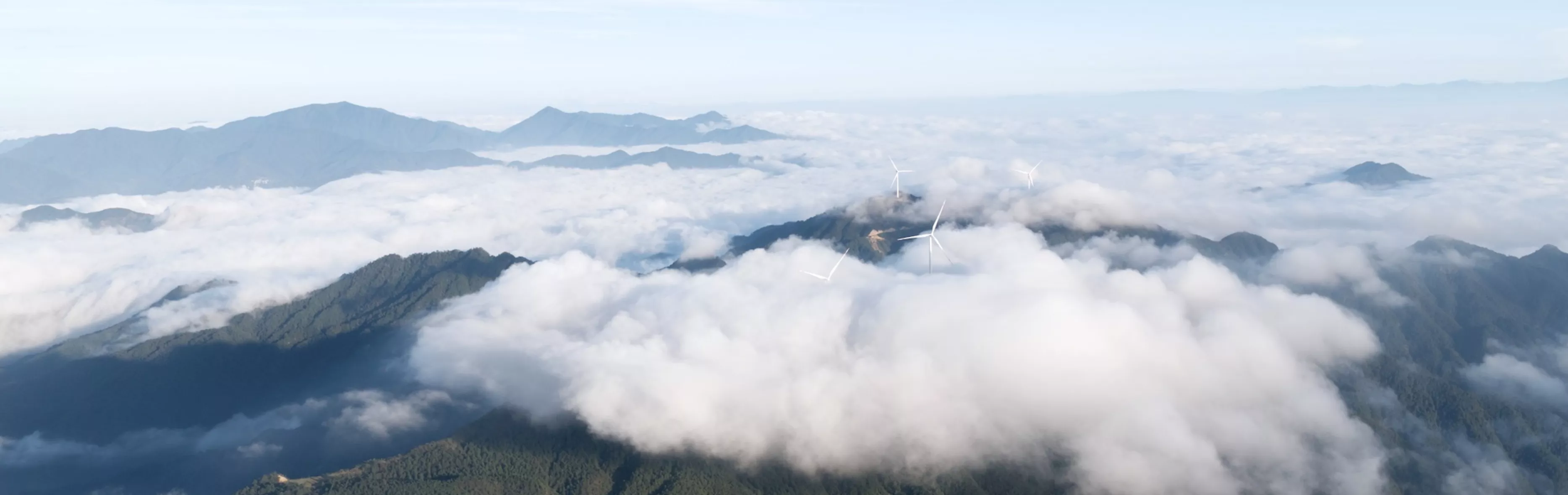
As South Korean companies accelerate their R&D efforts on ultra-large offshore wind turbine units, the country’s offshore wind power industry chain is moving toward comprehensive improvement. Currently, South Korea has established a complete domestic supply chain in the small- and medium-sized offshore wind power sector; however, it still faces gaps in core technologies for high-capacity wind turbines. With the government vigorously promoting the large-scale development of offshore wind power, whether this industry can become South Korea’s new engine for export growth is drawing widespread attention.
On February 9, according to the South Korean government, the Ministry of Climate, Energy and Environment has officially launched a research and development program for domestically produced, ultra-large-scale offshore wind turbines with a capacity of 20 MW each, in line with the national strategy to achieve an installed offshore wind capacity of 25 GW by 2035. As a complementary initiative, the Korea Energy Technology Evaluation Institute (KETEP), under the Ministry of Trade, Industry and Energy, is leading a nationwide R&D project for 20-MW offshore wind turbines. Doosan Enerbility and UNISON have already confirmed their participation in this project.
In addition to core wind turbine manufacturing, South Korea has already established strong competitiveness in the supporting sectors of offshore wind power: SK Oceanplant, GS E&C, and Hyundai Steel Industries are leading the way in the manufacture and installation of foundation structures; LS Cable & System and Taihan Cable & Solution hold key technologies for subsea cables; Hanwha Group is currently building specialized vessels for offshore wind farm installation; and CS Wind, the world’s No. 1 manufacturer of wind tower structures, continues to supply tower products to leading global turbine manufacturers.
Industry sources indicate that South Korea’s two sole domestic original equipment manufacturers—Doosan Enerbility and UNISON—have both successfully completed the R&D of 10-MW offshore wind turbines. Notably, Hyosung Heavy Industries, which had once withdrawn from the market, is also considering making a comeback. Reportedly, the company is currently evaluating the possibility of acquiring a wind turbine manufacturing license from Shanghai Electric in China.
Doosan Energy has currently completed the R&D of 8 MW and 10 MW offshore wind turbines and is conducting demonstration tests on the 8 MW prototype. If the demonstration phase goes smoothly, the company plans to deliver 13 8 MW units by March 2029. In addition, Doosan Energy is also in negotiations with Siemens Gamesa regarding the joint development of a 15 MW offshore wind turbine.
UNISON has also completed the R&D of a 10 MW offshore wind turbine and is about to begin performance verification. Once the turbine passes the tests, it will officially enter the commercialization phase.
Meanwhile, Hyosung Heavy Industries, which had withdrawn from the offshore wind power sector in the early 21st century, is also reportedly reevaluating its market strategy, with potential approaches including a rapid entry through technology licensing.
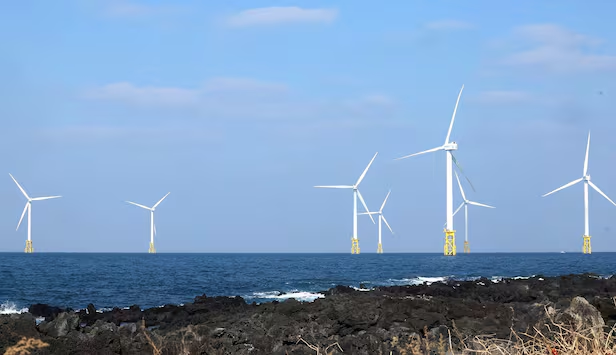
Jeju Hallim Offshore Wind Farm
Looking globally, offshore wind power is experiencing rapid growth. According to data from the Global Wind Energy Council (GWEC), as of the end of 2024, the world’s cumulative installed capacity of offshore wind power has reached 83 GW. Among this, China accounts for nearly half of the total with 41.6 GW, and has remained firmly at the top of the global list for new installations for seven consecutive years, ahead of the United Kingdom, Taiwan, China, Germany, and France.
Relying on their vast domestic market, Chinese companies have risen rapidly, not only consolidating their supply-chain advantages but also emerging as formidable contenders in the global competition. In addition to traditional industry giants such as Vestas and Siemens Gamesa, Chinese turbine manufacturers—including Goldwind, CSSC Heavy Industry Wind Power, and Sany Renewable Energy—have now joined the forefront of the offshore wind power sector.
In response, an official from South Korea’s Ministry of Climate said: “Offshore wind power is still in the early stages of industrial development. If South Korea can successfully master the core technologies for large-scale 20-MW wind turbines, it will achieve self-sufficiency across the entire industry chain.” He further pointed out: “Given that Taiwan, China, and Japan have adopted a cautious stance toward Chinese wind-power equipment, these markets are seen as key targets for South Korea’s expansion. Offshore wind power holds great potential to become another high-value-added export industry for South Korea, following semiconductors and batteries.”
Germany’s HKW was founded in 1921 and has been deeply focused on wind turbine bearings since 1985. Its technological expertise has spanned the entire evolution of the industry, and its technical strength in three-row cylindrical main bearings for wind turbines consistently ranks among the top three in Europe. HKW’s three-row cylindrical main bearings, backed by triple technological strengths—structure, materials, and manufacturing processes—boast six core advantages: high reliability, strong load-carrying capacity, robust structural rigidity, high transmission efficiency, ease of installation, and low overall costs. Whether adapted to onshore wind power scenarios or facing the challenges of salt spray corrosion and extreme wind and wave conditions in offshore wind farms, HKW’s three-row cylindrical main bearings can significantly reduce turbine downtime and maintenance frequency, enabling efficient adaptation across all onshore and offshore operating conditions. HKW remains deeply committed to the wind power supporting market and, leveraging its global, localized service network, provides cutting-edge technology and superior products to partners worldwide.