Recently, the World Wind Energy Association (WWEA) released its Global Wind Energy Half-Year Report 2026. Data shows that after the explosive growth of 2025, global wind power installations have clearly slowed in the first half of this year. However, this does not signal an inflection point for the industry. On the contrary, the second half of the year is likely to see an even stronger surge.
I. Growth slows in H1, but fundamentals remain solid
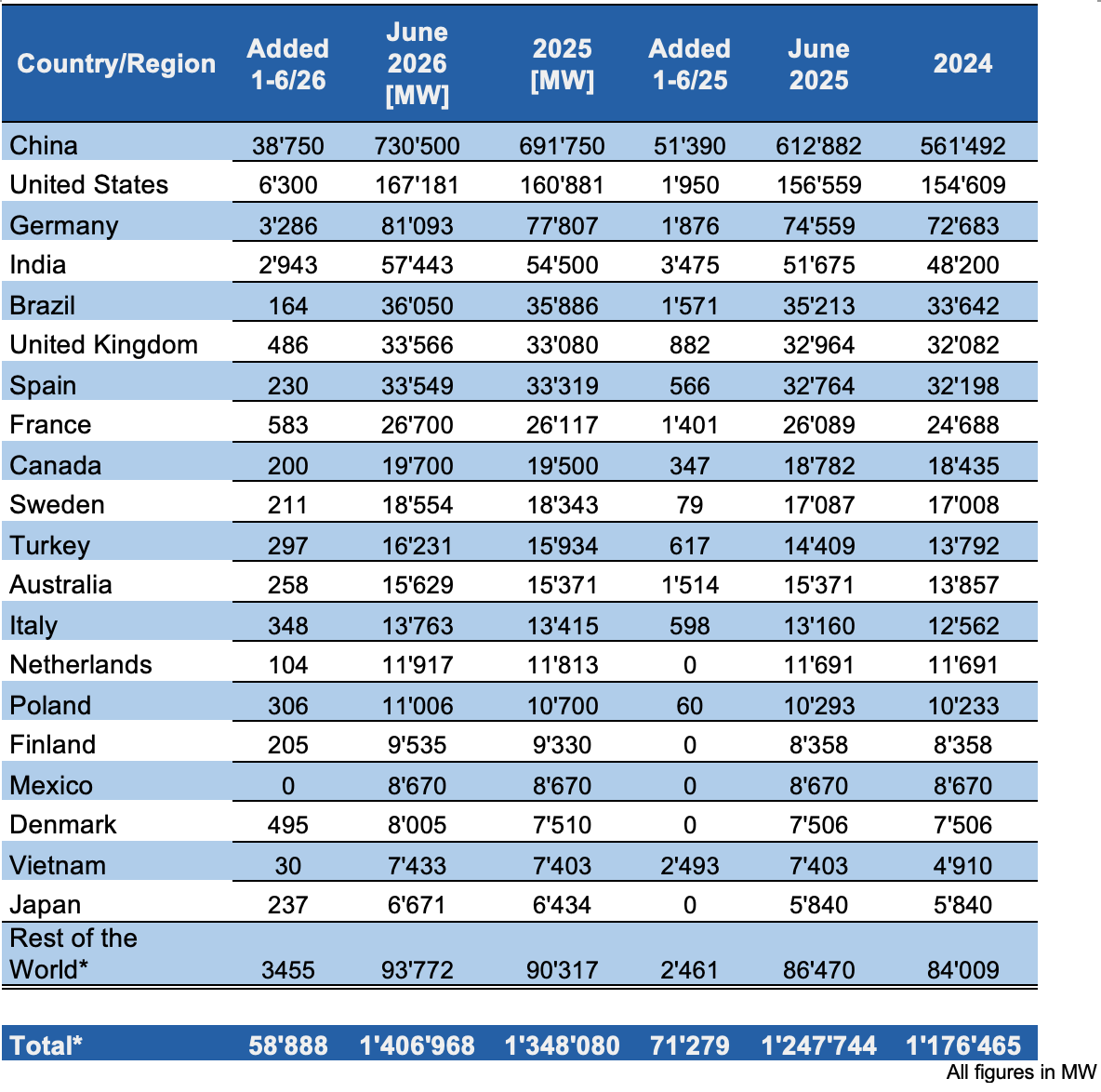
In the first half of 2026, global new wind power installations reached 58.9 GW, down 18% from 71.3 GW in the same period of 2025.
At first glance, this is a considerable drop. But taking a longer-term view, this year’s low point still stands at a historically high level:
H1 2022: 26.9 GW
H1 2023: 38.8 GW
H1 2024: 42.6 GW
H1 2026: 58.9 GW
In other words, even the slowed growth rate far outpaces any first-half figure between 2022 and 2024.
Rolling annual data paints an even more optimistic picture. In the 12 months from July 2025 to June 2026, global new installations hit 159 GW, up from 152 GW in the previous 12-month period. As of June 2026, total cumulative installed wind capacity worldwide had reached 1,407 GW.
In terms of growth rate, the global half-year growth rate stood at 4.4% in H1 (compared with 6.1% in the same period of 2025), with a rolling annual growth rate of 12.76%. The WWEA projects the full-year growth rate for 2026 at around 12.8%.
II. Full-year outlook: on track to match or even surpass the strongest year on record
Based on estimates from its member organisations, the WWEA forecasts that full-year new installations in 2026 will exceed 173 GW, slightly above 2025 levels and setting a new all-time record. This figure is also well ahead of 2024 (123 GW), 2023 (123 GW) and 2022 (85 GW).
By the end of 2026, total global installed wind capacity is expected to surpass 1,521 GW, meeting approximately 12% of global electricity demand. In the medium term, WWEA members forecast that global cumulative capacity will reach at least 2,250 GW by 2030.
This means over 114 GW of new capacity needs to be added in the second half. Given the historical pattern that H2 installations consistently outpace H1 (with H2 growth expected to exceed 8%), this target is well within reach.
III. Market landscape: China remains far ahead, but its share is narrowing
China remains undisputedly the world’s largest wind power market.
In H1 2026, China added 38.7 GW of new capacity. While down from 51.4 GW in the same period of 2025, this is still far higher than 2024 (25.8 GW) and 2023 (23.8 GW). China’s cumulative installed capacity has exceeded 730 GW, accounting for 52% of the global total.
Notably, China’s share of global new installations has fallen from nearly 80% in 2025 to 66%. This is not due to a slowdown in China, but rather to other markets starting to pick up pace.
Excluding China, only three countries added more than 1 GW of new capacity in the first half of this year: the United States, Germany and India.
IV. Notable country-level trends
United States: a "rush-to-install" wave that borrows from future growth. The US added 6.3 GW in H1, more than tripling its previous level. This momentum is expected to continue through 2027, driven by legislative and regulatory changes under the current administration, as developers rush to deploy projects before policy windows close. However, the WWEA has issued a blunt warning: these policy changes could lead to a collapse of the US market in the medium term. Short-term prosperity may store up medium-term risks.
Germany: record growth alongside uncertainty. Germany added 3.3 GW in H1, hitting a new record and nearly doubling the figure for the same period in 2025, benefiting from an improved regulatory environment. However, given mixed signals from the current government, new installations in Germany may peak in 2026.
India: slips from second to fourth place, but fundamentals remain intact. India added 2.9 GW in H1 (compared with 3.5 GW in H1 2025). Despite the drop in ranking, the results of long-term policy support are still evident.
Brazil: the steepest decline among major markets. New installations plummeted by nearly 90% year on year, dropping sharply from 1.6 GW to just 164 MW – the largest fall among all major markets.
UK vs Spain: a narrow 17 MW tussle. The ranking of the top 20 markets remains largely unchanged, with one minor twist: the UK overtook Spain by a slim margin of 17 MW.
Meanwhile, France (583 MW), Denmark (495 MW) and the UK (486 MW) make up the only three mid-sized markets in the "half-gigawatt" bracket, with both France and the UK posting sharp declines.
Conclusion: the long-term narrative for wind power remains unchanged
Taken as a whole, the report sums up global wind power in H1 2026 in one phrase: a short-term slowdown, but no change to the long-term trajectory.
The four major markets (China, the US, Germany and India) continue to drive growth; the full-year forecast of 173 GW is on track to set a new record; and the 1,521 GW cumulative capacity milestone is within sight.
All the data reaffirms wind power’s central pillar role in the global energy transition, and the fundamentals of long-term growth remain intact.