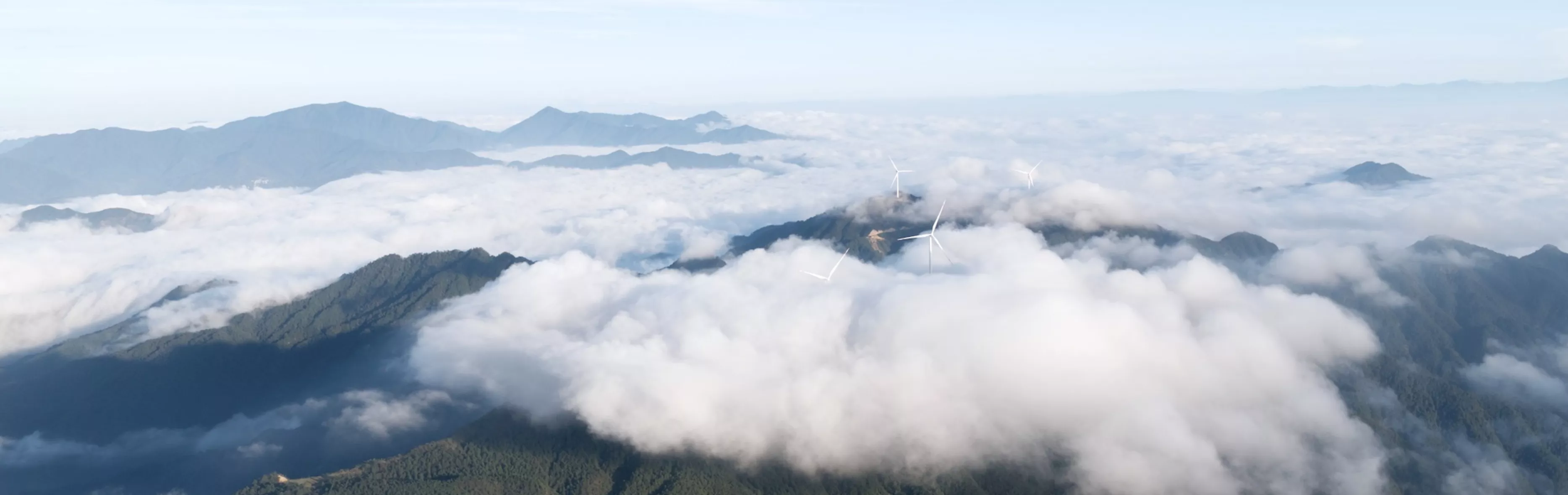
India's Ministry of New and Renewable Energy (MNRE) recently issued a revised document introducing key adjustments to the Approved List of Models and Manufacturers of Wind Turbines (ALMM-Wind). The mandatory implementation timeline for local prototype testing of wind turbines has been postponed by two years to balance localization development goals with the industry's actual capabilities, providing foreign enterprises with a more flexible compliance transition period.
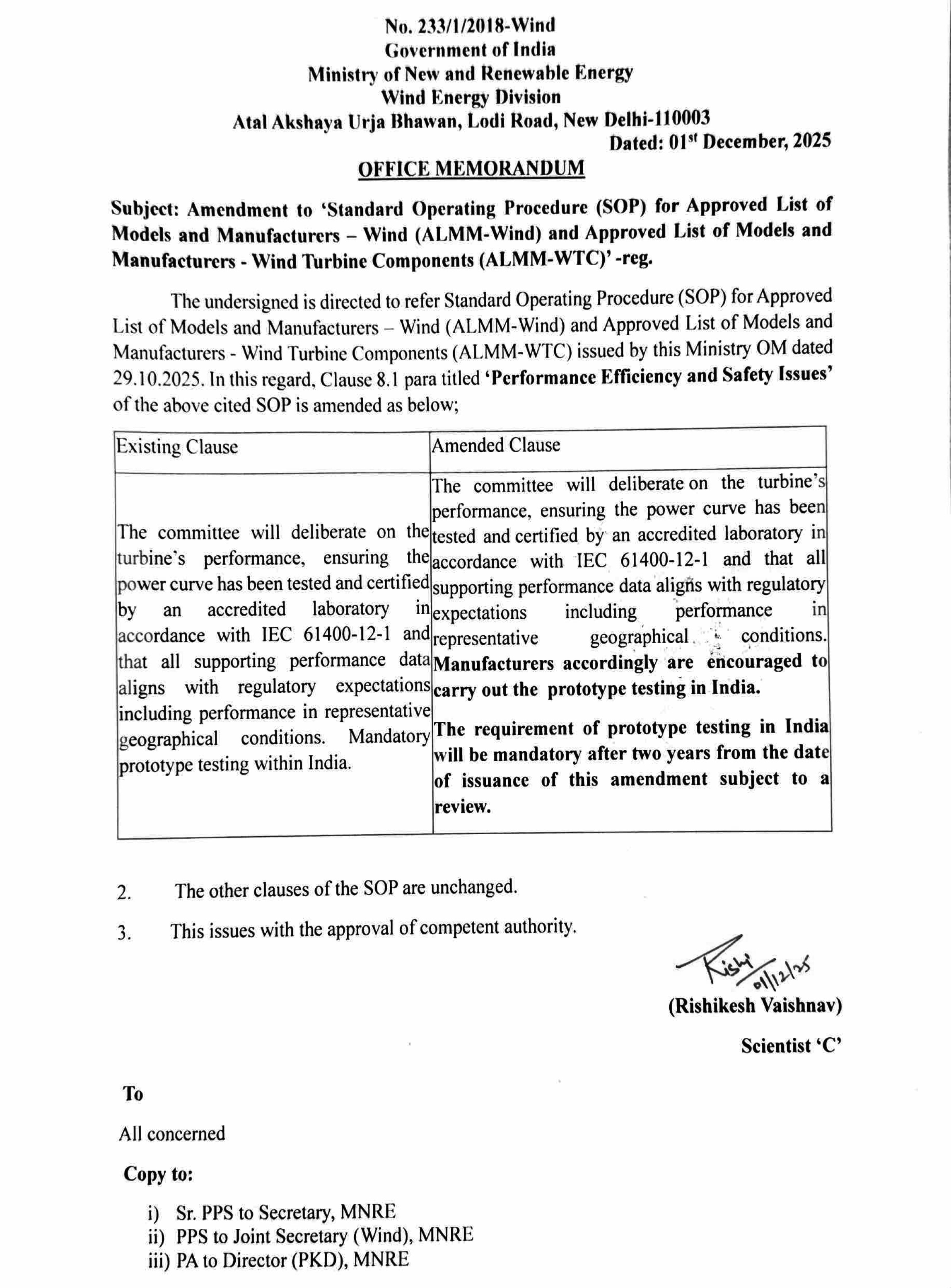
This revision, based on the official memorandum issued on December 1, 2025, adjusts ALMM-Wind Clause 8.1. The original requirement mandated that manufacturers applying for inclusion in the ALMM-Wind list must complete mandatory prototype testing within India to ensure equipment compatibility with local unique geographical and climatic conditions. The revision now states that “enterprises are encouraged to conduct local prototype testing.” The mandatory rule will take effect two years after the memorandum's issuance (December 1, 2027), with this timeline subject to future review based on industry progress and readiness. Notably, all other core requirements of ALMM-Wind remain unchanged. During the transition period, companies must still submit power curve test certification reports issued by accredited laboratories in accordance with the IEC 61400-12-1 standard.
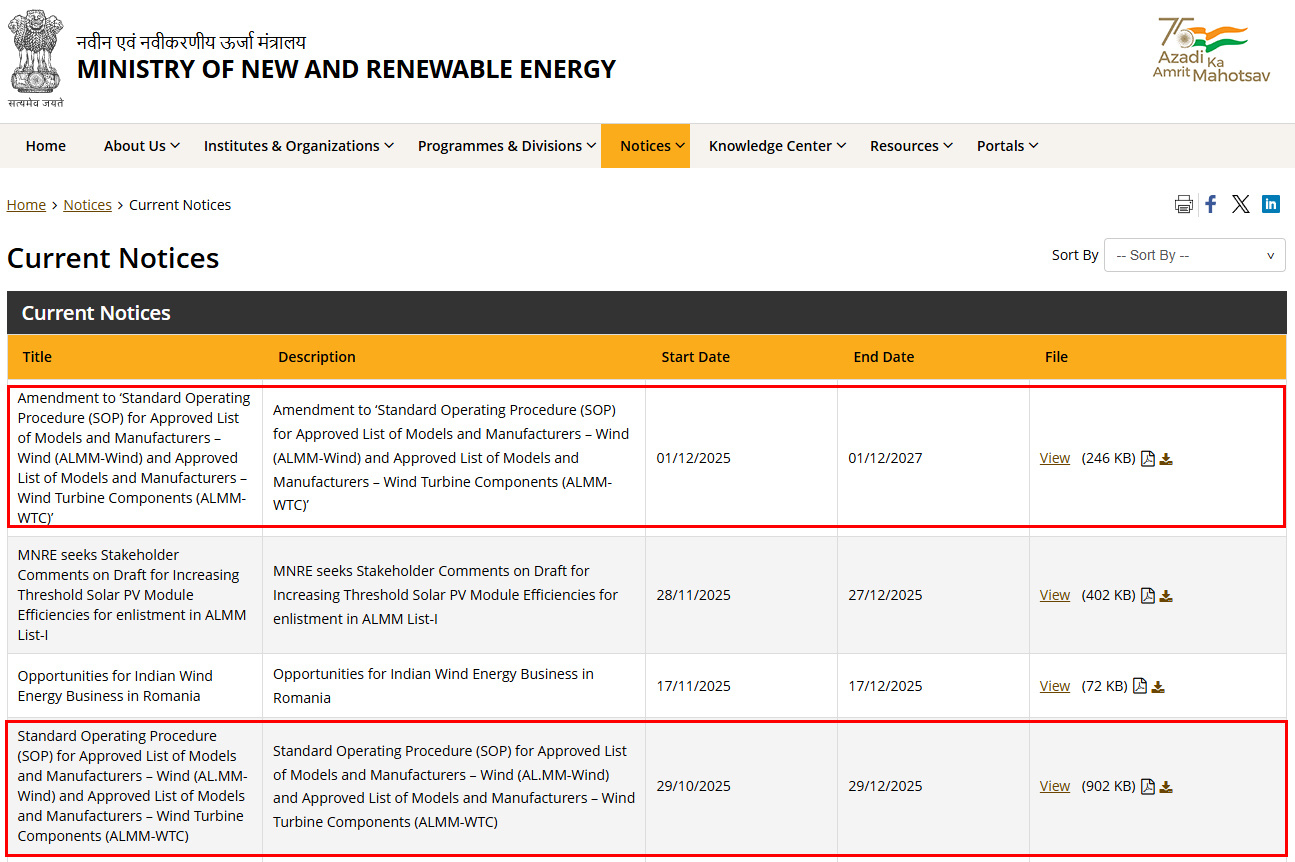
As a core component of India's wind power industry standard operating procedures (SOP), ALMM-Wind and ALMM-WTC were officially launched on October 29, 2025, establishing an access system for the wind power sector. Its key policies encompass three aspects:
Component Procurement
Component procurement must adhere to the ALMM-WTC Local Content List. Original Equipment Manufacturers (OEMs) must source critical components such as blades, towers, generators, gearboxes, and specialized bearings (main bearings, pitch bearings, yaw bearings) listed therein. The cost of procured components must account for 65%-70% of the total wind turbine cost. Additionally, the manufacturing/assembly facilities for these components must be explicitly identified and undergo MNRE qualification verification.
Cybersecurity and Data Governance
Wind power-related data centers and servers must be located within India. Operational data must be stored and maintained locally, with real-time data prohibited from being transferred across borders. Operational control must be executed through facilities within India.
Research and Development and Information Disclosure
Manufacturers must establish local R&D centers in India within one year of the policy's release. Manufacturers and models participating in the ALMM-Wind program must publicly disclose contact information, model specifications, quality certifications, and lists of key component suppliers on the MNRE official website to ensure supply chain traceability.
India's ALMM-Wind and ALMM-WTC policies center on “local supply chains + local R&D.” By mandating enhanced local manufacturing capabilities and reducing reliance on imported products—particularly those from China—these policies simultaneously ensure the quality and safety of wind power projects.
Following the implementation of the policy, domestic and international companies have already taken countermeasures:
Leading Chinese companies such as Envision Energy and Goldwind are accelerating their localization efforts. Envision Energy has established a 3GW blade manufacturing base in Tamil Nadu, India, and plans to expand nacelle and hub production capacity while building a new gearbox factory. The company aims to capture 50% of India's wind turbine market share by fiscal year 2026.
European companies like Siemens Gamesa favor technology licensing and local partnerships. Siemens Gamesa sold its onshore wind turbine business in India and Sri Lanka, retaining only a 10% stake. It supports Vayona Energy through long-term technology licensing to ensure product competitiveness.
Among domestic manufacturers, Suzlon and Inox Wind have benefited from policy support, with their order volumes projected to grow by 31% and 45% respectively by 2025. Suzlon plans to increase its domestic production capacity to 6GW by 2026, relying on R&D to reduce its dependence on imported bearings and generators.
Driven by both policy guidance and corporate expansion, India's wind power manufacturing potential continues to be unleashed, steadily advancing toward becoming a global hub for wind turbine production. India's installed wind power capacity has now surpassed 50GW, with plans to increase it to 100GW by 2030. Data from 2025 shows that India's domestically produced nacelles, blades, and gearboxes account for 12%, 10%, and 17% of the global market share respectively, establishing the country as an indispensable key node in the global wind power industry chain.
Founded in 1921, Germany's HKW has specialized in wind turbine bearings since 1985, accumulating technological expertise throughout the industry's evolution. Its three-row cylindrical main bearing technology consistently ranks among Europe's top three. Leveraging triple technological expertise in structure, materials, and manufacturing processes, HKW's three-row cylindrical main bearings deliver six core advantages: high reliability, strong load-bearing capacity, enhanced structural rigidity, high transmission efficiency, easy installation, and low overall cost. Whether deployed in onshore wind farms or confronting salt spray corrosion and extreme wave conditions in offshore environments, HKW's three-row cylindrical main bearings significantly reduce turbine downtime and maintenance frequency, delivering efficient performance across all operational scenarios. Deeply rooted in the wind power supply chain, HKW leverages its global localized service network to serve partners worldwide with cutting-edge technology and premium products.