By 2025, the global onshore wind power market will reach a critical turning point. Research by professional consultancy Wood Mackenzie indicates that global wind turbine manufacturers are simultaneously adjusting their product pricing strategies and core corporate strategies. Although Eastern and Western turbine manufacturers previously adhered to markedly different business models, they have now reached a consensus, collectively shifting toward a value-centric profit path.
Price Trends: Dual-Track Divergence Pattern Emerges
1. Western Markets: Prices have peaked; profitability takes priority.
Since 2020, Western wind turbine prices have risen cumulatively by 45%, with quoted prices in European and American markets now reaching $1 million to $1.2 million per megawatt (MW). Even with a 20% decline in commodity and logistics costs, the upward trend in turbine pricing shows no signs of slowing. Wood Mackenzie analysts indicate that current Western market turbine prices have peaked and are expected to gradually decline after 2027.
2. China Market: Decline Slows as Diversification Drives Breakthroughs
The decline in China's onshore wind turbine prices has significantly narrowed, with an annual average decrease of 3% projected through 2027—far below the rate seen five years ago. This shift indicates a maturing market and a gradual easing of price competition trends. Currently, the domestic price for onshore wind turbines including towers is approximately $300,000 per MW. Faced with intense domestic competition and overcapacity, manufacturers are increasingly expanding into project development, hybrid energy systems, and overseas markets to seek new growth opportunities.
Leveraging both domestic industrial and technological strengths, Chinese manufacturers continue to pursue aggressive pricing strategies in overseas markets, with complete units priced as low as $400,000 per megawatt in emerging markets. Wood Mackenzie forecasts that this price advantage will enable Chinese manufacturers to capture 27% of the global market share outside China over the next decade.
Strategic Transformation: From Price Competition to Value Deepening
1. Western manufacturers: Abandoning scale-driven approaches to focus on value creation
The massive financial losses incurred over the past five years have compelled Western original equipment manufacturers to abandon the competitive logic centered on scale expansion. New strategies now focus on modular design, AI-driven operations and maintenance systems, and digital upgrades, with the core objective of enhancing equipment reliability and asset returns. Simultaneously, sustainability, recyclability, and grid integration capabilities have emerged as key differentiators. Deepening component standardization and logistics collaboration have further reduced costs and alleviated delivery pressures.
2. Chinese Manufacturers: Moving Beyond Price Wars to Upgraded Solutions
China's leading equipment manufacturers are simultaneously advancing strategic upgrades, shifting from pure price competition to an end-to-end solution service model. Their operations now span project development, hybrid energy systems, and smart power trading platforms. In emerging markets, they are consolidating their market positions by establishing local manufacturing facilities, conducting workforce training, and building long-term cooperative networks. Concurrently, these companies are leveraging advanced technologies, ESG compliance capabilities, and intelligent platforms as their core strengths. By benchmarking against international industry leaders, they are forging differentiated competitive advantages.
Policy Adjustments: Driving Industry Transformation
Wood Mackenzie analysts believe that policy adjustments have become the core driver of corporate strategic transformation. China's 2025 power market reforms abolished the fixed electricity pricing mechanism and fully implemented competitive bidding models, converging with European market mechanisms. With these policy shifts, original equipment manufacturers (OEMs) now face not only intense competition within the industry but also challenges from cross-industry technologies like solar and energy storage, broadening the scope of industry competition.
Investor Confidence and Market Outlook
1. Confidence Boost: Impressive Stock Performance
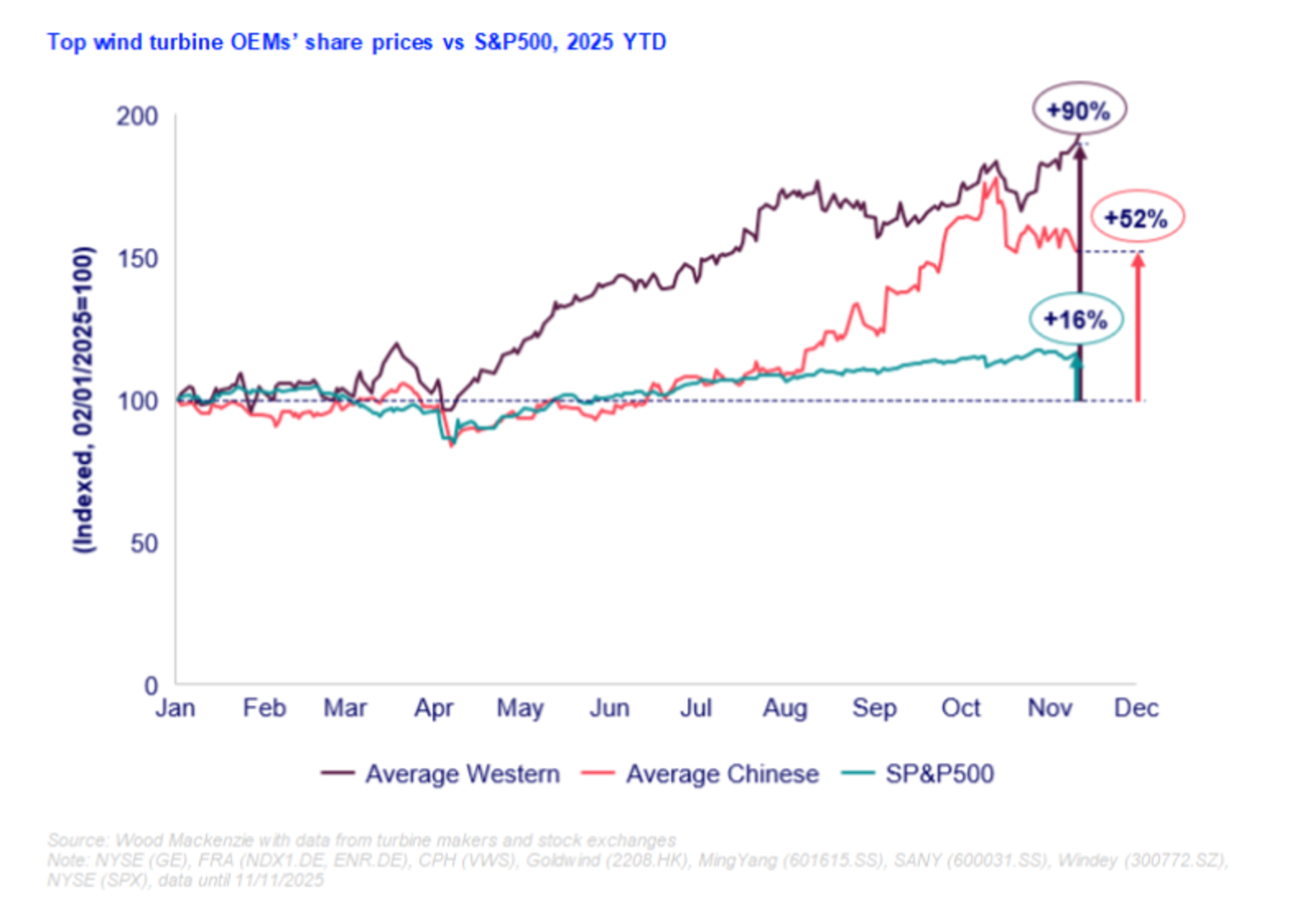
Corporate strategic transformation has significantly boosted market confidence. According to Wood Mackenzie research data, shares of Chinese and Western wind turbine manufacturers have surged by an average of 72% since the start of this year. Western companies have primarily benefited from supply chain improvements and streamlined EU approval processes, while Chinese firms have achieved growth through domestic policy support and industry consolidation dividends.
2. Challenges Remain: The Road to Transformation Is Long and Arduous
The industry still faces multiple challenges: Chinese manufacturers expanding overseas must address structural obstacles such as rising local manufacturing costs, increased logistical complexity for large-megawatt units, and delays in establishing operations and maintenance networks. Western manufacturers, meanwhile, need to strike a balance between revenue generation and technological innovation investments to withstand sustained market competition pressures.
3. Industry Outlook: Value-Driven Future Landscape
Wood Mackenzie analysts note that the strategic convergence between Chinese and Western companies signals the onshore wind power industry's entry into a new phase of development driven by technology and system integration. A successful transition will propel the wind power sector toward restored healthy profitability and solidify its position as a core pillar in the global decarbonization process. Companies unable to adapt to this transformation may face risks of sustained profit pressure and shrinking market share.
Founded in 1921, Germany's HKW has specialized in wind turbine bearings since 1985, accumulating technological expertise throughout the industry's evolution. Its triple-row pillar main bearing technology consistently ranks among Europe's top three. Leveraging triple technological expertise in structure, materials, and manufacturing processes, HKW's three-row pillar main bearings deliver six core advantages: high reliability, strong load-bearing capacity, enhanced structural rigidity, superior transmission efficiency, easy installation, and low overall cost. Whether deployed in onshore wind farms or confronting salt spray corrosion and extreme wave conditions in offshore environments, HKW's three-row pillar main bearings significantly reduce turbine downtime and maintenance frequency, delivering efficient performance across all operational scenarios. Deeply rooted in the wind power supply chain, HKW leverages its global localized service network to serve partners worldwide with cutting-edge technology and premium products.