According to UK government officials, the British government plans to unveil a new wind power price reform policy on Tuesday, April 21, in response to the sharp surge in energy prices triggered by geopolitical conflicts. Centered on voluntary fixed-price subsidies and differentiated tax regulation, the new policy will fully decouple electricity prices from natural gas prices, dismantle the long-standing "gas-electricity bundling" mechanism in the UK power market, and bring down the cost of green electricity.
Source: Bloomberg
In recent weeks, UK wholesale power prices have surged again, jumping from around £74/MWh to over £100/MWh. Prices are set to climb further if energy supply disruptions persist into winter. Against this backdrop, the UK government’s reform aims not only to curb electricity prices but also to remove institutional barriers to the energy transition.
Two-pronged Approach of the New Policy
The reform targets older wind and solar farms, which account for nearly one-third of the UK’s power generation. The government is offering a voluntary fixed-price subsidy option: farms that sign new Contracts for Difference (CfD) will secure a guaranteed stable feed-in tariff and avoid market volatility risks.
To force companies to comply, the policy is supplemented with "rigid constraints": Old power plants that refuse to sign contracts will face a higher proportion of "excess profit tax", the tax rate currently already reaching 45%.
Break down the chain of interests
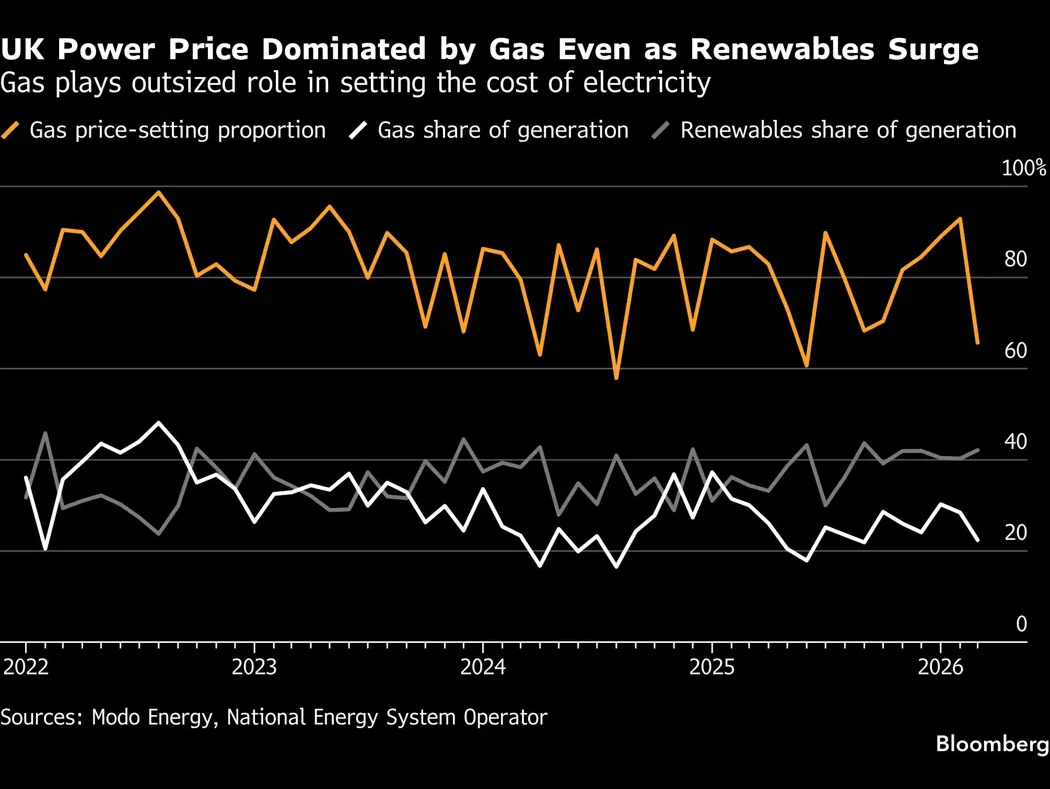
The deep contradiction in the UK's electricity pricing mechanism stems from the dominance of natural gas power generation in setting the prices for the wholesale market. Although the proportion of green electricity such as wind and solar power has increased, the price fluctuations of natural gas, which is the marginal pricing fuel (i.e., the last energy source that determines the highest market price), will directly push up the overall electricity prices.
Under the old system, low-cost legacy wind and solar farms actually profited from high electricity prices: they enjoyed a guaranteed minimum subsidy while arbitraging at elevated market rates, even reaping excess profits from soaring gas prices. This created a distortion where "clean energy profited from high gas prices" — the public bore the cost of expensive gas, while green power failed to deliver its cost advantages.
Core of the New Policy
The reform restructures the profit distribution mechanism through Contracts for Difference (CfD), establishing a new model of risk-sharing and benefit-sharing:
When the market prices is high: The power station is required to return to the government the excess profits above the fixed price, and ultimately pass this reduction on to consumers.
When the market prices is low: the government covers the difference to ensure reasonable returns for power generators.
This mechanism eliminates revenue uncertainty for investors and fundamentally insulates end-user electricity bills from swings in gas prices. It stands as a key measure for the UK to stabilize energy prices and accelerate its clean energy transition.